BOB Explains How Solvers Screen BOB Gateway Swaps
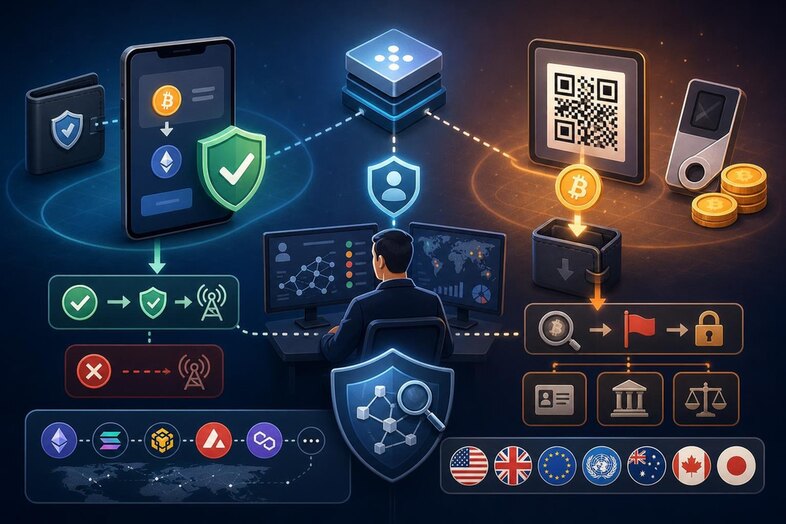
BOB says every swap routed through BOB Gateway undergoes wallet screening by the solver that fills the order, using third-party blockchain analytics tools to assess sanctions and illicit-activity risk. In an explanation of the process, BOB details which addresses are checked and how screening timing differs between connected-wallet swaps and walletless QR-code swaps. The post describes existing procedures; it does not announce a new screening system or a change to Gateway’s operation.
Screening focuses on addresses and transaction history
BOB Gateway matches a swap request with a solver. The solver receives the assets offered by the user and sends the requested assets in return. BOB says each solver conducts its own compliance screening, so the checks are performed by the order-filling party rather than by the Gateway protocol itself.
The screening described by BOB evaluates blockchain addresses using public on-chain information and third-party tools. The process can compare addresses with sanctions lists and other watchlists maintained by regulators or law enforcement. It can also trace funds through earlier transactions to identify possible exposure to activities such as theft, scams, ransomware, darknet markets or sanctioned parties. A risk score may take into account an address’s activity, its direct counterparties and indirect exposure.
That approach is different from identity verification. BOB says wallet screening assesses the address and the history associated with funds; it does not, by itself, require the protocol to know the user’s identity. The company presents the checks as a way for solvers to manage compliance obligations while Gateway can be used without an account or an identity check in the ordinary swap flow. A later review can involve a request for identity information in certain walletless cases.
Solvers, not the Gateway protocol, handle holds
BOB says addresses associated with a swap, including sending and receiving addresses, are screened on every chain supported by Gateway. The checks cover applicable sanctions lists, with the post naming lists associated with the United States, United Kingdom, European Union, United Nations, Australia, Canada and Japan. It also says solvers screen for connections to theft, fraud and other illicit activity, and complete checks before releasing funds.
The distinction between Gateway and its solvers matters when a check flags activity. According to BOB, the Gateway protocol does not hold or freeze funds. A solver may nevertheless have to stop a swap or hold assets it has received, based on the solver’s own screening and compliance obligations. BOB also says solvers review their screening settings regularly, balancing risk controls with access for legitimate users. It does not identify a single shared scoring threshold or analytics provider in the explanation.
Connected wallets are checked before broadcast
In the connected-wallet flow, a user links a wallet and initiates a swap in the app. BOB says screening takes place before the transaction is broadcast. If the check fails, the swap does not proceed, the user’s assets do not leave the wallet and no fee is charged.
This timing means the solver can screen the addresses involved before the user sends the transaction, according to BOB’s description. The flow is the stated option for users who want a screening decision before funds leave their wallet. The post does not say that using a connected wallet guarantees approval; the solver’s checks still determine whether it will fill the swap.
Walletless swaps are screened after deposit confirmation
For a QR-code or walletless swap, a user can send assets from a wallet, exchange or hardware device without connecting that wallet to the app. BOB says the sending address is not known until the deposit arrives, so screening occurs after the deposit confirms. That creates a different point at which a flag can affect the user: if the solver identifies a concern, it is obligated to hold the funds while the case is reviewed.
BOB says flagged cases may be reviewed manually where possible to help identify errors. Depending on what the screening finds, the matter may need to be reported to relevant authorities. In some cases, funds can only be released with authorization from an authority or court. The solver is legally prohibited from disclosing the reason funds are held, according to the post, and it may ask the user for information such as identification or a liveness check as part of a review.
These are possible outcomes described for flagged walletless swaps, not a claim that every deposit is delayed or that a particular result follows from every risk score. BOB does not provide a timeline for reviews or specify a universal threshold in its explanation. The post says compliance holds are governed by clause 2.6 of BOB’s Terms of Service and advises users who believe a screening error occurred to use the stated legal-review channel; no case-specific details are offered there.
Screening is performed across supported chains
BOB characterizes wallet screening as common practice among major exchanges and many DeFi platforms, bridges and swap services. Its explanation frames the checks as a solver-level compliance measure, rather than a feature that changes the underlying assets or turns Gateway into a custodian. The practical difference for users is chiefly when an address can be checked: before broadcast with a connected wallet, or after deposit confirmation in a walletless flow.
For both routes, screening applies to addresses tied to the swap, and the solver decides whether it can proceed under its compliance checks. BOB’s stated procedure therefore separates the Gateway’s role in matching orders from the solver’s responsibility for screening and, where required, holding assets. The checks run on every supported chain, while walletless screening begins only after the incoming deposit confirms.