Citrea Sets Pomelo Upgrade to Move Rollup and Clementine Proving to Succinct’s SP1
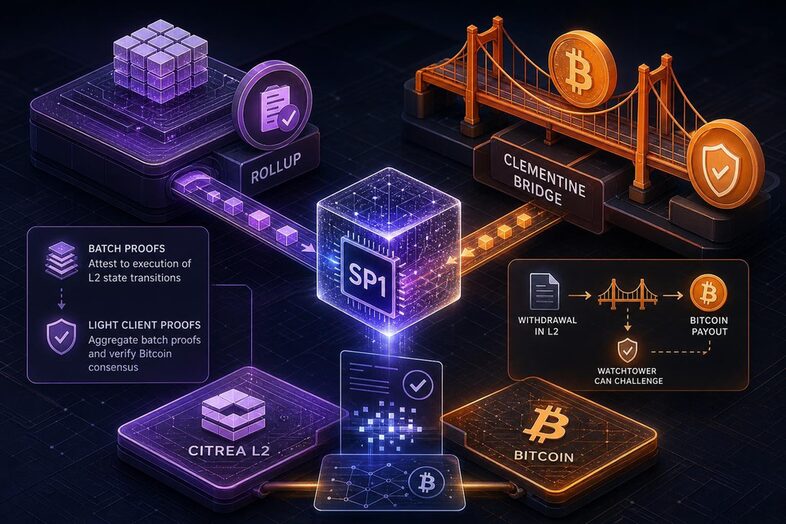
Citrea announced that its Pomelo mainnet upgrade would migrate both rollup proving and Clementine bridge proving to Succinct’s SP1 zero-knowledge virtual machine (zkVM). The project’s announcement scheduled the rollout to begin on November 23, 2026, and said full node operators should update their software by November 25 ahead of an L2 fork activation. The announcement describes a planned upgrade; it does not confirm that the migration has since activated.
Pomelo also includes a series of fixes, though Citrea did not detail them in the announcement. The change affects the proving infrastructure behind two distinct functions: verifying Citrea rollup state transitions and supporting Clementine’s Bitcoin bridge proofs. Citrea said the transition would place both proving workloads on SP1, rather than limiting the migration to one of those components.
Upgrade timing and expected interruptions
Citrea’s published schedule set the start for Monday, November 23, at 3:00 PM UTC. It said the initial rollout would take place within a three-hour upgrade window and could cause a few minutes of Citrea mainnet downtime. The announcement separately described an initial prover migration window of three to four hours, after which it did not expect further mainnet interruptions on Monday. These timings describe the planned process, not a report of measured downtime.
The rollup upgrade was expected to finish within the three-hour window. Clementine could take longer, depending on how quickly its distributed Signer set completed the upgrade. Citrea said the bridge handles transfers of 10 BTC or multiples of that amount, and that ordinary mainnet activity and everyday users would remain unaffected while Clementine completed its portion of the migration.
Full node operators were asked to install the updated nodes between the initial Monday rollout and Wednesday, November 25, so they would remain in sync when the L2 fork activated. Citrea said it planned to issue a formal notice 12 hours before the start. The announcement also described a post-upgrade statement with links to the relevant GitHub repositories and details about the SP1 integration and fixes, but it did not include those materials or confirm that the upgrade had concluded.
Where SP1 fits in Citrea’s proving design
Citrea described its existing proving architecture as a two-tier system built around Batch Proofs and Light Client Proofs. Batch Proofs attest to execution of Layer 2 state transitions. Light Client Proofs aggregate those batch proofs and verify Bitcoin consensus, including proof-of-work and difficulty adjustments, according to the project’s description.
The distinction matters because the two proof types serve different parts of the system. Batch proofs concern the rollup’s execution, while light client proofs connect that rollup proof history to Bitcoin consensus for the bridge. Citrea said the light client proofs feed into Clementine. Moving both rollup and bridge proving to SP1 therefore changes the zkVM used across these functions, while leaving their described roles distinct.
Citrea said its proving circuits run inside a zkVM, which executes standard program logic and produces cryptographic proofs. SP1 is built on a RISC-V architecture and can prove standard Rust code, which Citrea identified as a fit for its Rust-based proving stack. The announcement said Succinct would partner with Citrea on the migration and cited streamlined proof generation, performance, and security as expected benefits. Those are project-stated reasons for the choice, not independent findings or measured results supplied in the announcement.

Rollup proofs and bridge withdrawals
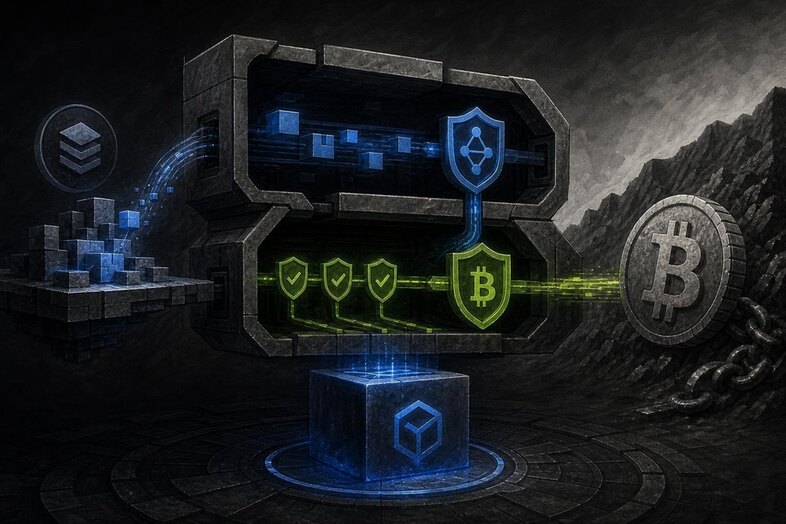
For rollup proving, Citrea said its prover monitors Bitcoin for finalized sequencer commitments. A dedicated Batch Prover maintains a replica of the L2 state and coordinates with the zkVM to generate batch proofs for state transitions. The proofs and state differences are then published to Bitcoin, which Citrea uses as a data availability layer. The project said this arrangement lets the full Citrea state be reconstructed from Bitcoin blockspace.
This description separates proof generation from data availability. The zkVM generates proofs about execution, while the stated publication of proofs and state differences makes the material needed for reconstruction available on Bitcoin. Citrea did not say that Bitcoin directly executes or checks each individual Layer 2 transaction. Instead, its described proving chain uses batch proofs for rollup transitions and light client proofs to verify Bitcoin consensus.
Clementine uses those light client proofs as part of a separate bridge proof. Citrea said the bridge proof checks that a withdrawal occurred in Citrea’s finalized L2 state and uses simplified payment verification (SPV) to confirm that an operator paid the user on Bitcoin. In the project’s description, the proof validates both the L2 withdrawal claim and the corresponding Bitcoin payout.
The bridge uses BitVM2 and an optimistic challenge mechanism, according to Citrea. The bridge circuit checks withdrawal payouts, while at least one honest online participant, called a Watchtower, can challenge an invalid claim. The announcement describes this as optimistic ZK proof verification encoded through BitVM2; it does not claim that every bridge claim is automatically settled without the possibility of challenge.
Citrea’s stated migration scope is therefore specific: SP1 is slated to power proving for both the rollup and Clementine, while the bridge continues to rely on its described light client proofs, payout checks, and Watchtower challenge process. The operator deadline in the published schedule was November 25, 2026, before the L2 fork activation.