Citrea Reports 150 BTC in Clementine Bridge Volume After Six Months

Citrea says its Clementine Bitcoin bridge processed 150 BTC in total bridging volume during its first six months in production, with deposits restricted to 10 BTC or multiples of that amount. The project presents the figure as a milestone for a BitVM-based bridge connected to a programmable Bitcoin layer.
Clementine moves BTC between Bitcoin Layer 1 and Citrea, where the bridge issues cBTC. Citrea describes cBTC as a BTC representation on its programmable layer. The project says Clementine uses BitVM and zero-knowledge cryptography, and that its peg-out design relies on an optimistic verification process on Bitcoin using BitVM2.
Deposits follow a fixed path
A Clementine peg-in begins when a user sends 10 BTC to a Taproot address with two spending paths, according to the project’s description. The bridge path requires signatures from all signers and includes the user’s EVM address. A separate refund path lets the user reclaim the deposit after a 200-block timelock if the bridge does not act.
Signers then move the deposit into a vault UTXO. Citrea says this transaction constrains the funds to Clementine’s pre-approved exit paths. Once the vault transaction has at least six confirmations, a bridge smart contract on Citrea checks it through a Bitcoin light client contract. If verification succeeds, the system mints 10 cBTC to the user’s Citrea address.
The deposit flow therefore includes both a Bitcoin-side confirmation condition and a Citrea-side verification step. The source specifies the 10 BTC denomination, the 200-block refund delay, and the six-or-more-block finalization threshold; it does not report the number of deposits or the amount currently held in the bridge.
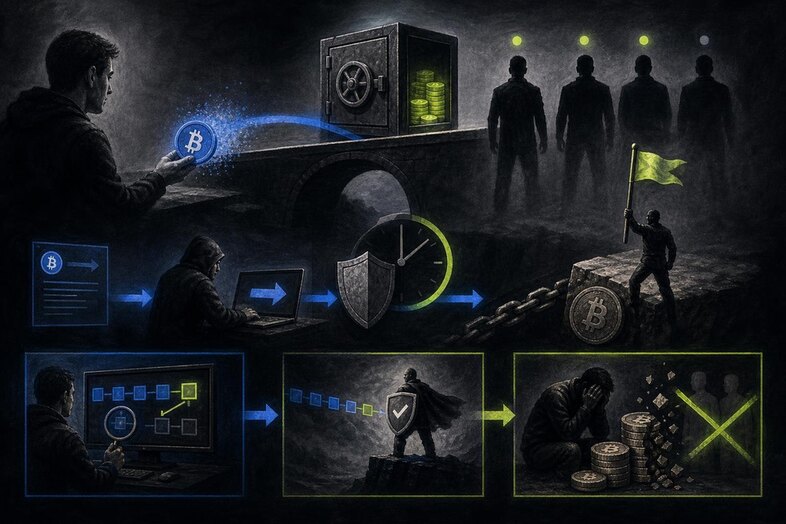
Withdrawals use optimistic claims and challenges
For a peg-out, a user burns cBTC through the system contract’s safeWithdraw function and submits a payout transaction template to the operators. Citrea says signers can make an optimistic payout if they are online. If a signer remains offline for 12 hours, an operator can attach its own input to the user’s template with SIGHASH_SINGLE|ANYONECANPAY and pay the user on Bitcoin L1 before seeking reimbursement.
The operator requests reimbursement by posting a KickOff claim to Bitcoin, which starts a dispute window. If no challenge is made, the operator can reimburse itself from the bridge vault. If a challenger disputes a fraudulent claim, a watchtower posts a proof of the current finalized canonical Bitcoin header chain. The operator must then provide a zkSNARK light-client proof showing that its committed chain has more proof-of-work and includes the valid user payout, according to Citrea’s account.
Citrea says an operator that cannot provide a valid proof loses the challenge, has its BTC collateral slashed, and is removed from the operator set. The project also says operators lock slashable collateral that backs a round of multiple user withdrawals, so a successful challenge can affect the operator’s entire collateral for that round.

Trust assumptions and planned changes
Citrea characterizes Clementine’s peg-out security as a 1-of-N honesty assumption: it says one honest signer and one honest watchtower are sufficient to prevent an incorrect peg-out from succeeding. This describes the project’s stated security model, rather than independent confirmation of the bridge’s performance. The source also claims resilience against an attacker controlling less than approximately 45% of Bitcoin’s hash rate, but provides no further qualification or test results for that figure.
Citrea says it is working on a Clementine redesign using BitVM3, with the stated aims of reducing required operator collateral and simplifying the protocol. The project said it would release a technical write-up about the planned design, but the source does not give a publication date or describe a deployment. The reported production volume covers Clementine’s first six months, and each peg-in remains subject to the bridge’s 10 BTC-or-multiple requirement.